Introduction
Shopping for clothes can be an incredibly satisfying experience, but navigating the confusing, inconsistent landscape of modern women’s sizing can quickly turn it into a nightmare. Whether you are shopping for a sharply tailored blazer, a flowing summer dress, or the perfect pair of everyday jeans, finding the right fit hinges entirely on understanding how clothing sizes work. The reality is that the number or letter on the tag often feels completely arbitrary. This is why having a standardized, comprehensive women’s clothing size chart is not just helpful—it is absolutely essential.
The fashion industry unfortunately lacks a universal, globally enforced sizing standard. A size 8 in one brand might fit perfectly, while a size 8 in another brand might refuse to zip past your hips. Throw in international sizing differences—such as shopping from European designers or Australian boutiques—and the complexity multiplies. Furthermore, modern phenomena like “vanity sizing” complicate the picture, meaning a size 12 from thirty years ago is completely different from a size 12 today. Consequently, online shopping often yields frustrating returns, wasted time, and bruised egos when clothes simply do not fit as expected.
This comprehensive guide is designed to demystify the women’s clothing size chart. In this article, you will learn the exact steps required to take accurate body measurements at home, understand the nuanced differences between regional sizing systems (like US, UK, and EU), and learn how specific fabrics, cuts, and categories (like Petites or Plus) interact with your body type. We will also introduce an invaluable internal size adjustment calculator tool that simplifies the entire process. Beyond just charts and numbers, we have included an extensive “Alterations Guide” to help you understand what tailoring can (and cannot) fix when off-the-rack garments are almost, but not quite, perfect.
By the end of this guide, you will be equipped with the expert knowledge required to confidently shop anywhere, for any item of clothing, armed with an accurate female size chart and the strategies to ensure an impeccable fit.
The Evolution of The Clothing Size Chart
To truly understand how to use a female size chart effectively, it helps to understand why sizing is so inherently complex today. Unlike men’s clothing, which is traditionally measured in absolute inches (such as neck circumference and sleeve length), women’s clothing sizes have historically relied on an abstract numbering system.
Why Standardization Failed
In the mid-20th century, the United States attempted to create a universal sizing standard by gathering anthropometric data from thousands of women. However, the data collected was fundamentally flawed. It excluded large demographics and relied heavily on military women, who were generally fitter and younger than the average civilian population. As a result, the “standard” hourglass figure that became the baseline for early clothing patterns did not reflect the beautiful diversity of actual women’s bodies.
Over the decades, as the average human body size changed and global trade expanded, the so-called “standard” fell completely out of use. Brands began developing their own proprietary block patterns, meaning that a brand targeting high schoolers uses a vastly different fit model than a brand targeting corporate executives.
The Phenomenon of Vanity Sizing
You cannot discuss a modern clothing size chart without addressing vanity sizing. Vanity sizing (also known as size inflation) is the industry practice of assigning smaller size numbers to garments with larger physical dimensions. This marketing tactic is designed to make consumers feel better about fitting into smaller sizes, thereby increasing their likelihood of purchasing.
For instance, a waist measurement of 28 inches would have been classified as a size 12 or 14 in the 1950s. Today, that exact same waist measurement is often categorized as a size 6 or even a size 4 depending on the fast fashion retailer. Because vanity sizing varies wildly from brand to brand, relying solely on to the number printed on the label is practically guaranteed to fail. The only foolproof method is relying on your exact bodily measurements in inches or centimeters and cross-referencing them against the manufacturer’s specific size chart.
How to Take Accurate Body Measurements
Before you even look at a womens clothing size chart, you need your unique, updated body measurements. Taking measurements at home is a simple process, but doing it incorrectly is the leading cause of poor fit.
Tools You Will Need
To begin, you will need a soft, flexible measuring tape (often made of vinyl or cloth). Do not attempt to use a rigid metal tape measure designed for construction, as it simply will not contour to the curves of the human body. Ideally, you should also have a full-length mirror, or better yet, a friend to assist you.
When taking these measurements, wear form-fitting undergarments (like leggings and a supportive bra) or take them directly against bare skin. Measuring over bulky sweaters or thick denim will skew your numbers dramatically, resulting in garments that are far too large.
Step 1: Measuring Your Bust
The bust measurement is critical for dresses, blouses, shirts, and jackets.
- Stand up straight with your arms relaxed at your sides. (If a friend is helping, have them measure while your arms are down; if you are measuring yourself, keep your elbows as close to your sides as possible).
- Wrap the tape measure around the fullest part of your chest. This usually aligns with your nipples.
- Ensure the measuring tape is perfectly parallel to the floor all the way around, especially across your back.
- The tape should be snug enough so it does not slip down, but loose enough that you can easily breathe. Do not compress your chest tissue.
Step 2: Measuring Your Natural Waist
Your natural waist is not necessarily where your pants sit. It is the narrowest part of your torso.
- To locate your natural waist, bend gently to one side. The crease that forms is your natural waistline, typically located an inch or two above your belly button.
- Wrap the tape measure around this exact point.
- Relax your stomach. Do not “suck in,” as this will result in clothing that is painfully tight and impossible to sit down in.
- Keep the tape parallel to the floor, allowing for about a finger’s width of space between your body and the tape to ensure comfortable breathing room.
Step 3: Measuring Your Hips
The hip measurement is vital for pants, jeans, skirts, and fitted dresses.
- Stand naturally with your heels completely together.
- Locate the absolute fullest, widest part of your lower body. This includes your buttocks and your hips, typically falling roughly 7 to 9 inches below your natural waist.
- Wrap the tape measure entirely around this area, making certain the tape remains parallel to the floor. (Using a full-length side mirror helps ensure the tape isn’t drooping in the back).
- Again, the tape should be flush against your skin without digging in.
Step 4: Measuring the Inseam
The inseam determines the length of pants, trousers, and jeans.
- Stand straight with your legs slightly apart.
- Measure down the precise inner seam of your leg, starting at the topmost part of your inner thigh (crotch) and dragging the tape straight down to the bottom of your ankle or where you want your pants to end.
- Take note of what type of shoe you wear most often. If you wear 3-inch heels, you may want to add three inches to your standard flat inseam measurement when purchasing trousers.
- If measuring your own body proves difficult, take a pair of pants you already own that fit perfectly and measure their inner seam while they lay flat on a table.
Step 5: Measuring Shoulder Width and Arm/Sleeve Length
These measurements are critical for outerwear, tailored blazers, and long-sleeve tops.
- Shoulder width: Measure straight across your upper back, going from the prominent edge (shoulder socket bone) of one shoulder to the outer edge of the other.
- Sleeve length: Start the tape measure at the center back of your neck (at the prominent spine bone), run it down over your shoulder cap, down the outside of your slightly bent elbow, and stop right at your wrist bone.
Document all these measurements in both inches and centimeters (CM), as many international brands rely strictly on the metric system. Update your measurements every 6 to 12 months.
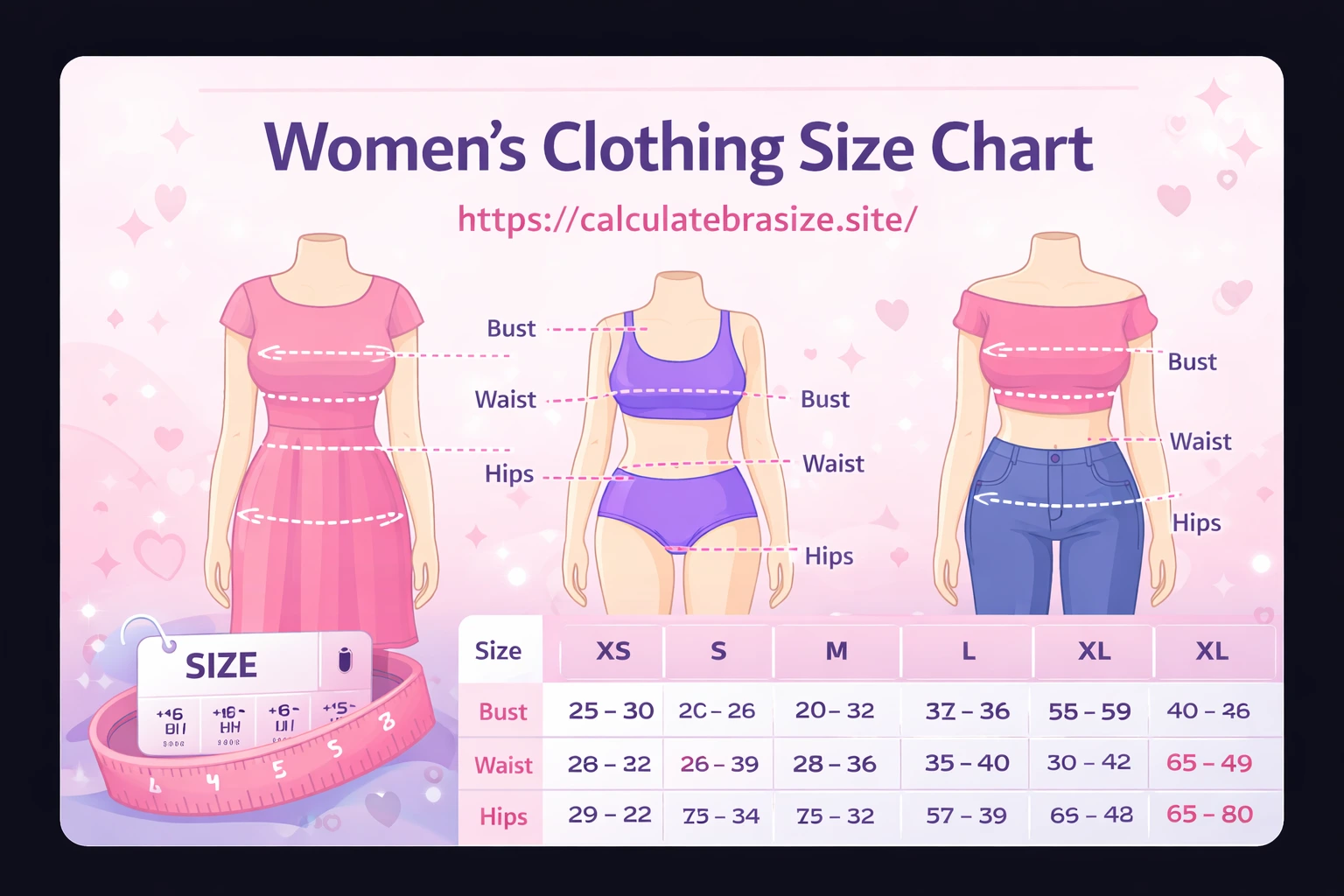
The Ultimate Women’s Clothing Size Chart
Once you have your measurements in hand, you can consult a general female size chart. Remember, the chart below represents general industry standard averages. When shopping online, ALWAYS verify these numbers against the specific retailer’s provided size chart.
Standard US Alpha to Numeric Sizing Chart
This table outlines the correlation between broad alpha sizing (XS, M, XL) and their corresponding numerical sizes, alongside average body measurements in inches.
| Alpha Size | Numeric Size | Bust (Inches) | Waist (Inches) | Hips (Inches) |
|---|---|---|---|---|
| XXS | 00 | 31″ – 32″ | 23.5″ – 24.5″ | 33″ – 34″ |
| XS | 0 – 2 | 32″ – 34″ | 24.5″ – 26″ | 34″ – 36″ |
| S | 4 – 6 | 34″ – 36″ | 26″ – 28″ | 36″ – 38″ |
| M | 8 – 10 | 36″ – 38″ | 28″ – 30″ | 38″ – 40″ |
| L | 12 – 14 | 38″ – 41″ | 30″ – 33″ | 40″ – 43″ |
| XL | 16 – 18 | 41″ – 44″ | 33″ – 37.5″ | 43″ – 47″ |
| XXL/2XL | 20 – 22 | 44″ – 47″ | 37.5″ – 41″ | 47″ – 50″ |
Decoding International Sizing Systems
Shopping globally expands your wardrobe exponentially, but different countries utilize entirely different structural numbering metrics. Understanding the conversion rules allows you to navigate European luxury boutiques, fast-fashion retailers in the UK, and Japanese streetwear brands with ease.
US to UK and Australia Sizing
The United Kingdom, Australia, and New Zealand largely share the same sizing framework. As a solid rule of thumb, US sizes run approximately two sizes smaller (or four numerical digits lower) than UK/AU sizes.
- If you are a US size 6, you will generally be a UK/AU size 10.
- If you are a US size 12, you will generally be a UK/AU size 16.
US to European (EU) Sizing
European sizing applies across most of the continent, with prominent exceptions being Italy and France. The EU system usually starts in the low 30s.
- If you are a US size 2, you are typically an EU 32.
- If you are a US size 8, you are an EU 38.
- A simple formula to estimate your EU size is to take your US size and add 30. (e.g., US 10 + 30 = EU 40).
US to French and Italian Sizing
France and Italy are dominant forces in global fashion, but their sizing runs notoriously small and tight.
- France (FR): French sizing typically adds 32 to the US size. A US 6 is essentially a French 38.
- Italy (IT): Italian sizing typically adds 36 to the US size. A US 6 corresponds to an Italian 42. Furthermore, Italian clothing is cut leaner and narrower in the hips and bust, meaning many women have to size up regardless of the conversion chart.
Global Size Conversion Quick-Reference Table
Use the following table to quickly cross-reference major global sizing metrics:
| US Size | UK / AU Size | EU Size | FR Size | IT Size | JP Size |
|---|---|---|---|---|---|
| 00 | 4 | 30 | 32 | 36 | 3 |
| 0 | 6 | 32 | 34 | 38 | 5 |
| 2 | 8 | 34 | 36 | 40 | 7 |
| 4 | 10 | 36 | 38 | 42 | 9 |
| 6 | 12 | 38 | 40 | 44 | 11 |
| 8 | 14 | 40 | 42 | 46 | 13 |
| 10 | 16 | 42 | 44 | 48 | 15 |
| 12 | 18 | 44 | 46 | 50 | 17 |
| 14 | 20 | 46 | 48 | 52 | 19 |
| 16 | 22 | 48 | 50 | 54 | 21 |
| 18 | 24 | 50 | 52 | 56 | 23 |
Understanding Specialty Sizing Categories
The shape of the human body is vastly more complex than a simple measuring tape can capture. Two women can have identical 36-28-39 measurements, but if one is 5’1″ and the other is 5’10”, they cannot wear the exact same dress. This is where specialized categories enter the clothing size chart ecosystem.
Misses Sizes
“Misses” is the default standard in American womenswear. It is engineered for the average female height, typically ranging from 5’4″ to 5’7″. The fit model used for Misses sizing usually possesses a relatively balanced hourglass shape. Misses sizes are usually denoted by even numbers (2, 4, 6, 8, etc.).
Junior Sizes
Many assume Junior sizing simply means “clothing designed for teenagers,” but it technically refers to a distinct body shape cut. Junior clothing is cut for bodies with less dramatic curves. The bust and hip ratios are less pronounced compared to the waist, and the overall garment length is slightly shorter. Junior sizes are easily identifiable because they always utilize odd numbers (1, 3, 5, 7, 9, 11). A Junior size 7 is roughly equivalent to a Misses size 6, but cut much straighter in the hips.
Petite Sizes
Petite sizing has absolutely nothing to do with weight or width; it has everything to do with height and vertical proportions. Petite sizing is designed specifically for women who fall 5’4″ and under. Unlike simply chopping the hemline off standard Misses pants, authentic Petite clothing adjusts the entire architecture of the garment. The armholes are raised, the inseam is shortened, sleeve lengths are reduced, and the natural waistline of dresses and tops is lifted higher to align with shorter torsos. Petite sizes are marked with a “P” (e.g., 6P, S-P).
Plus Sizes (Women’s Sizes)
Also referred to as “Women’s sizing,” Plus sizing applies to garments generally over a size 14 or 16. Just like Petites, Plus sizing involves re-grading the entire block pattern to accommodate broader proportions dynamically, rather than just scaling up a size 4 pattern mathematically. Plus sizes allow for more room in the upper arm, a full bust, a proportional hip drop, and often a higher rise in the stomach to prevent gaping. Plus sizes are denoted either by extended even numbers (16W, 18W, 20W) or by alphanumeric scaling starting with an X (1X, 2X, 3X, 4X). Note that an XXL is not identically structured to a 2X; the 2X guarantees more generous room in the chest and arms.
Tall Sizes
As the direct opposite of Petites, Tall sizing serves women standing 5’8″ and above. The structural grading extends pant inseams (regularly past 34 inches), elongates sleeves by roughly one to two inches, and lowers the waistline so that tailored dresses align correctly onto the natural waist, preventing empire-waist malfunctions. Tall sizes usually carry a “T” suffix (e.g., 10T, L-T).
Category-Specific Sizing: Tops, Dresses, and Jeans
When using a female size chart, the rules slightly bend depending on exactly what garment you are attempting to buy.
Sizing for Tops and Blouses
For unstructured t-shirts and casual sweaters, standard Alpha sizing (Small, Medium, Large) is generally sufficient. However, for structured, woven blouses, your bust and shoulder measurements dictate the final fit entirely. If you have broad shoulders or a large chest, you must match the size chart to your largest upper-body measurement. If the blouse fits beautifully in the shoulders but is slightly loose in the waist, that is perfectly acceptable—that can be taken in. If it fits the waist but constricts the shoulders, it is fundamentally unwearable.
Sizing for Dresses
Dresses are the most difficult garments to fit off-the-rack because they must simultaneously accommodate your bust, waist, and hips. When consulting a dress size chart:
- A-line and Fit-and-Flare Dresses: Match the size strictly to your bust and natural waist measurement. The hip measurement is irrelevant because the skirt flares away from the body.
- Sheath, Bodycon, and Pencil Dresses: Match the size to your absolute largest measurement. If your hips map to a size 12 on the chart, but your waist and bust map to a size 10, buy the size 12. A tailor can easily take in the top, but they cannot invent extra fabric for your hips.
Sizing for Pants and Jeans
Denim frequently bypasses standard Misses sizing in favor of exact waistband measurements in inches. A size “28” jean means the waistband measures exactly 28 inches. However, the true fit varies massively depending on the rise of the jean.
- High-rise jeans sit at the natural waist, so a size 28 means your natural waist must be 28 inches.
- Low-rise jeans sit down by the hip bones. A size 28 low-rise jean will physically measure closer to 32 inches around the physical waistband in order to span the wider circumference of the hips.
The Role of Fabric and Stretch in Your Size
Knowing your exact dimensions is only half the battle. The other half is evaluating the fabric composition of the garment. Fabric stretch fundamentally alters the way clothing corresponds to an established clothing size chart.
Wovens vs. Knits
- Woven Fabrics: Materials like structured denim, raw linen, pure cotton poplin, silk, and severe wool are woven. These fabrics possess absolutely zero mechanical stretch. When buying a garment made of 100% woven material, the item must either perfectly match your body measurements or be slightly larger (known as “ease”). You can never size down in pure wovens.
- Knit Fabrics: Materials used for t-shirts, yoga pants, jersey dresses, and lightweight sweaters are knitted. These loops of fabric stretch naturally. Knit items offer a heavy amount of physical forgiveness. When dealing with soft knits, you can afford to straddle sizes or even intentionally size down for a tighter, body-hugging aesthetic.
The Power of Elastane (Spandex/Lycra)
Modern fashion relies heavily on synthetic stretchy fibers woven into otherwise rigid materials.
- A pair of jeans made entirely of 100% cotton holds no give; therefore, size charting is incredibly strict. You might require a size 10 to clear your thighs.
- A pair of jeans structured as 98% cotton and 2% elastane (spandex) alters the fit matrix dramatically. Even just 2% stretch allows denim to mold to a body’s particular shape. Knowing this, many women prefer to purchase stretch denim slightly tighter (say, a size 8) knowing the fabric will eventually “relax” and mold perfectly throughout the day without sagging.
Alterations Guide: Making Off-The-Rack Fit Like Couture
The biggest secret in Hollywood style and high fashion is not magic; it is tailoring. Off-the-rack clothing is designed to fit a mathematical, hypothetical average. Since extremely few women fit this statistical average perfectly, relying heavily on a professional alterations guide is the most mature, stylish approach to shopping.
Rather than tearing through racks desperately seeking a garment that magically caters to your broad bust and extremely narrow waist seamlessly, smart shoppers buy for their largest measurement and alter the rest exclusively.
Easy and Inexpensive Alterations
When utilizing a sizing chart, do not disqualify a garment if you know it falls under an “easy fix” category. The following alterations are quick, cheap, and simple for any basic dry-cleaner or tailor to execute:
- Hemming pants and skirts: Shortening the leg or the skirt length is the easiest alteration imaginable. If you find incredible pants, buy them regardless of length.
- Taking in the waist: If a dress fits your bust or hips perfectly but bags loosely at the waist, a tailor can easily put in darts or take in the side seams to give you an hourglass taper.
- Shortening straps: Spaghetti straps or sleeveless tank tops that hang too low can be clipped and lifted at the shoulder seams in minutes.
- Adding bra cups: Need structure in an evening gown? A tailor can sew molded cups directly into the lining so you can discard the bra completely.
Difficult, Expensive, or Impossible Alterations
Conversely, if an off-the-rack garment exhibits any of the following sizing issues down the line, do not buy it. No clothing size chart will save you from these structural misfits:
- Letting out seams: Making clothing bigger is nearly impossible. Modern manufacturing leaves less than half an inch of excess fabric inside the seams. If a dress is genuinely too tight across the back, it is unwearable.
- Re-cutting armholes and shoulders: If a tailored blazer extends three inches past your actual shoulder edge, modifying it requires removing the entire sleeve, recutting the shoulder architecture, and reattaching the sleeve. It is a wildly expensive procedure that rarely looks correct. The shoulder fit must be immaculate off-the-rack.
- Lengthening garments: Unless there is a noticeable deep, folded hem visible at the bottom of the skirt or pant leg, it is essentially impossible to add physical length to a garment.
Using this Alterations Guide, aim for an “80% perfect” fit off-the-rack regarding the female size chart, and rely on a strong tailor for the remaining 20%.
Simplifying Fit: How Our Size Adjustment Calculator Helps
Despite memorizing your exact measurements, remembering the complexities between Junior sizing and Misses stretch blends across international borders can feel like solving algebraic equations simply to buy a winter coat. We developed an advanced feature directly into our framework to shoulder the rigorous math.
You can calculate this easily using our size adjustment calculator.
This specialized digital tool is designed to instantly interpret your specific dimensions and convert them directly into any format necessary.
How to Use the Calculator
- Input Your Baseline Data: Simply drop your bust, waist, and hip circumferences (in either inches or centimeters) into the calculator’s primary fields.
- Select Your Destination System: Whether you intend to purchase a UK 14 dress, a French 40 jacket, or a 28-inch waist American jean, select the corresponding international output.
- Evaluate for Nuance: The engine not only offers the immediate numerical answer, but additionally adjusts parameters based on whether the final piece is “high stretch” or “rigid woven,” keeping you from making an expensive mistake.
Common Mistakes When Reading a Female Size Chart
Even with precise measurements, consumers frequently misread or misuse the size chart itself. Avoid these common pitfalls to maximize your success rate.
Mistake 1: Extrapolating One Brand’s Size to Another The single most prevalent mistake is assuming that because you are a confirmed, true size 10 in Abercrombie & Fitch, you must automatically be a size 10 in Ralph Lauren or Prada. Different brands create different target demographic profiles. Never assume; always check the specific chart connected to that exact brand.
Mistake 2: Measuring Over Bulky Clothing Measuring hips while wearing thick corduroy trousers or sweatpants can genuinely add up to two full inches to your actual circumference. This instantly bumps your sizing up inappropriately. Measure tight to the curve.
Mistake 3: The Danger of “Sucking It In” It is human nature to desire the smallest number possible, leading many women to suck in their abdomens drastically while holding the measuring tape. However, unless you plan on walking through life holding your breath continuously, your clothes will feel torturous the moment you inhale. Measure your waist naturally, totally relaxed.
Mistake 4: Not Looking at the Product Description or Fit Model Specs Brand size charts offer strict biological measurements, but fashion dictates style. Does the item say “Oversized Fit” or “Relaxed Cut”? If it does, and you order your exact size, the garment will arrive looking massive—because it is supposed to. If you want a tailored look despite an oversized description, size down. Furthermore, check the “Model Measurements” at the bottom of the page in small text. If an online model is 5’11” and the maxi-dress grazes her ankles, understand that the same dress will drag two feet on the floor if you are 5’3″.
Expert Pro Tips for Shopping Online Successfully
Armed with your measurements and a reliable size chart, integrate these pro shopping tips to ensure higher triumph rates and fewer aggravating trips to the post office for returns.
- Hunt for Detailed Reviews: Customer reviews are your ultimate defense mechanism. Skim the comments specifically hunting for notes on the fit. Customers usually explicitly warn if a garment runs small, runs large, shrinks aggressively in the washer, or possesses zero stretch. Listen to them.
- Order Two Sizes if Allowed: If the website offers a flexible, free return policy and the budget allows, order the item in both the size your measurements mandate and the size above it. Keep the flawless fit, and immediately ship the other size back.
- Analyze the “Ease” Requirement: As noted in our “Alterations Guide,” garments need breathing room. In clothing design, “ease” is the difference between body measurement and garment measurement. A winter down-coat requires at least three to four inches of extra, negative ease because you must wear it layered over thick sweaters. A cocktail top needs zero ease. Keep the garment’s intent in your mind.
Conclusion
Understanding the intricacies of the women’s clothing size chart empowers you to shop confidently across designers, fabrics, and international borders. By abandoning reliance on confusing vanity sizing labels and prioritizing exact physical body measurements, you strip the anxiety and frustration completely out of the shopping equation. Armed with a soft measuring tape, a fundamental understanding of how stretch impacts structure, and a knowledgeable alterations guide up your sleeve, the nightmare of ill-fitting garments vanishes. Always verify against specific brand charts, remember that fabrics and styles override numbers, and trust in the ease and speed of an effective size adjustment calculator to guarantee you step out the door possessing the absolute perfect fit, every specific time.
Frequently Asked Questions (FAQs)
How do I find a womens clothing size chart that is accurate?
The most accurate size charts are the specific, proprietary charts hosted on the direct website of the brand you are purchasing from. General industry charts provide an excellent starting reference, but individual brands dictate their unique fit specifications that override standard assumptions.
Why do clothing sizes differ so wildly between brands?
Clothing sizes vary dramatically because there is no enforced, universal international regulatory body dictating a standard template. Brands operate by building fit models based on their specific, localized target demographics. Add the marketing psychology phenomenon of “vanity sizing,” and the sizing metrics become incredibly distorted.
Which international dress size system runs the smallest?
Generally, Italian sizing runs the absolute smallest across the global board, favoring very narrow shoulders, extremely lean hip drops, and minimal bust accommodation. Asian sizing systems (like Japan) are similarly structured very small and petite. Contrastingly, American sizing usually runs the largest and features the most generous hip-to-waist ratios.
Does my bra size immediately dictate my shirt size?
No, a high cup size does not inherently dictate a larger structural shirt frame. Your bra tells you volume, but a shirt relies on your overall circumference including back width. That being said, if your bust is heavily disproportionate to your waist, you must size your woven shirts to fit your bust measurement correctly, and then rely on a professional tailor to artificially taper the waist down.
What does the “W” mean in women’s pants sizing?
When you encounter a “W” after a number on a clothing label (such as 16W or 22W), it explicitly stands for “Women’s” sizing. This is the fashion industry’s official terminology for authentic Plus-sizing. It indicates that the entire physical pattern of the pants has been restructured to accommodate fuller proportions, wider hip drops, and thicker upper thighs, significantly separating it from a standard Misses size 16.
If I want an oversized look, should I rely on the size chart and size up?
It depends purely on the designer’s intent. If an item is explicitly marketed and described as an “oversized fit” top, simply order your normal size according to the sizing chart—the looseness is already mathematically built into that pattern. However, if you want a garment designed originally as a “slim fit” tee to look baggy and relaxed, you must intentionally size up one or even two full sizes above what the size chart recommends.