Have you ever ordered a stunning pair of shoes online, eagerly awaited their arrival, and then realized they pinch your toes or slip right off your heels? You are not alone. With the rise of international e-commerce, shopping globally for footwear has never been easier, but navigating the maze of global shoe sizing remains a massive headache for millions of women around the world. Finding the correct shoe size conversion is the key to preventing returns, saving money, and most importantly, protecting your foot health.
Understanding your exact measurements through a reliable feet size chart is the foundational step for any footwear purchase. The difference between an American shoe size and an EU shoe size is not just a simple numerical shift; it represents completely different historical systems of measurement. Whether you are eyeing a pair of handcrafted Italian leather boots or high-performance running sneakers designed in the United States, utilizing a precise foot size conversion chart will ensure you step out in total comfort and style.
In this comprehensive, expert-level guide, we will break down everything you need to know about measuring your feet at home, decoding an EU shoe size chart, avoiding common online shopping mistakes, and understanding how a foot size converter works. We will dive deep into the nuances of shoe widths, seasonal foot swelling, and brand-specific quirks. Finally, we’ll show you how you can calculate this easily using our Shoe Size Converter tool.
Get ready to demystify shoe sizes once and for all!
1. The Anatomy of a Perfect Fit: Why Shoe Size Matters
Before we dive into the mathematics of a shoe size conversion table, it is essential to understand exactly why getting the right fit is critical. Shoes are not just fashion accessories; they are structural support systems for the human body.
The Medical Consequences of Ill-Fitting Shoes
Wearing shoes that are improperly sized—whether they are too tight, too loose, too narrow, or too drastically arched—can cause microscopic daily traumas to the bones, ligaments, and tendons of your foot. Over time, these minor irritations compound, leading to chronic and sometimes debilitating foot conditions.
- Bunions (Hallux Valgus): Wearing shoes with a narrow toe box that pinches the toes together can exacerbate bunions, a painful bony bump that forms on the joint at the base of your big toe.
- Plantar Fasciitis: Shoes lacking proper arch support or size mismatch can strain the plantar fascia, the thick band of tissue running across the bottom of your foot. This leads to sharp, stabbing heel pain.
- Hammertoes and Corns: Small shoes force your toes to curl. This unnatural position leads to hammertoes, while the constant friction against the top of the shoe creates painful corns and calluses.
- Blisters and Ingrown Toenails: Friction from a shoe that is slightly too large can cause devastating blisters on the heel, while shoes that are too short pound against the nailbed, causing painful ingrown toenails.
The Biomechanics of Walking
Your foot is an engineering marvel, comprising 26 bones, 33 joints, and over 100 muscles, tendons, and ligaments. During a normal gait cycle, your foot hits the ground (heel strike), rolls forward to absorb shock (pronation), and pushes off the toes (propulsion).
If you are wearing an incorrect US foot size, your foot’s natural biomechanical flow is disrupted. For example, if the shoe is too big, your toes will reflexively “grip” the sole of the shoe to keep it from slipping off. This continuous artificial tension leads to severe foot fatigue and shin splints. Alternatively, if a shoe is too small, your arch will not align with the shoe’s built-in arch support, causing hip and lower back pain as your body attempts to compensate for the imbalance.
Knowing your accurate measurements using a foot size chart for shoes is the ultimate form of preventative healthcare for your lower extremities.
2. How to Measure Your Feet at Home (Step-By-Step Guide)
You cannot accurately use a shoe size conversion chart. if you do not know your baseline measurements. A startling number of women are walking around in the wrong shoe size simply because they haven’t measured their feet since their late teenage years. Your feet change dynamically due to weight fluctuations, pregnancy, and the natural loss of ligament elasticity through aging.
Here is the foolproof, step-by-step guide to measuring your feet at home to find your true foot size.
What You Will Need:
- Two pieces of standard printer paper (A4 or Letter size)
- A pencil or pen
- A ruler or measuring tape (capable of measuring in both centimeters and inches)
- The type of socks or tights you intend to wear with the shoes you are buying
Step 1: Prep and Timing
Pro Tip: Always measure your feet at the end of the day. Throughout the course of a day, the pressures of walking and gravity cause fluid to pool in your lower extremities. By the late afternoon or evening, your feet are at their maximum, swollen size. Measuring in the morning almost guarantees you will buy shoes that become uncomfortably tight by dinnertime.
Step 2: Position the Paper
Tape the piece of paper to a hard, flat floor (avoid carpet, which distorts the measurement). Ensure one edge of the paper is seated perfectly flush against a straight wall.
Step 3: Plant Your Foot
Stand straight up with your heel touching the wall, resting firmly on the paper. You must be standing, as bearing your full body weight naturally spreads and elongates the foot.
Step 4: Trace and Mark
Have a friend or partner trace the outline of your foot. If you are doing this alone, bend your knee slightly to reach down, but keep your weight firmly planted. Keep the pencil completely vertical (at a 90-degree angle to the floor). Do not angle the pencil underneath the toes or far away from the foot. Make a distinct mark at the tip of your longest toe. Note: For many people, the second toe is actually longer than the big toe (this is known as Morton’s Toe). Then, make marks at the widest parts of the left and right sides of your foot (usually around the ball of the foot).
Step 5: Measure the Distance
Remove your foot. Use your ruler to measure the straight-line distance from the heel edge (the wall) to the mark of your longest toe. This gives you your foot length. Next, measure the distance between the two marks at the widest point of your foot. This gives you your foot width.
Step 6: Measure the OTHER Foot!
This step is critical. Up to 60% of adults have one foot that is noticeably larger than the other. Always measure both feet and use the measurements of the larger foot when consulting a foot size conversion table. You can always pad a slightly loose shoe, but you can never shrink your foot to fit a tight shoe.
Step 7: Add a Buffer Margin
Once you have your maximum length in centimeters, add roughly 0.5 to 1.0 cm (about 1/4 to 1/2 inch) to the measurement. This is the required “wiggle room” or “toe spring” margin needed so your toes don’t smash against the front of the shoe when you walk.
3. The Global Sizing Standard: US vs. EU vs. UK
In a perfect world, footwear brands would use one universal metric to dictate shoe sizes. Instead, we are left with a patchwork quilt of regional sizing conventions based on centuries-old measurement techniques. To understand how an American shoe size to EU conversion works, we must briefly review the history of these scales.
The American (US) System
The US sizing system is derived from the old English “barleycorn” measurement. One barleycorn equals exactly 1/3 of an inch. In the traditional system, a size 12 is roughly 12 inches long, and every full size decrements by a barleycorn (1/3 of an inch). Furthermore, women’s US shoe sizes are traditionally mapped 1 to 1.5 sizes larger than men’s sizes. Therefore, a men’s size 7 is equivalent to a women’s size 8 or 8.5.
The European (EU) System
The EU shoe size system is often considered much simpler and more universal. It uses a metric measurement known as the “Paris Point.” A Paris Point is equal to 2/3 of a centimeter (or roughly 0.26 inches, or 6.67 millimeters). Unlike the US and UK systems, the EU system does not generally differentiate between male and female sizes; the scale is absolute based on the internal length of the shoe last. Because the increments between EU sizes are smaller than US sizes, EU sizing is often viewed as more precise.
The United Kingdom (UK) System
The UK system, much like the US system, is based on the barleycorn. However, it starts measuring at a different “zero point.” Generally, an adult US woman’s size is equal to the UK size plus 2 or 2.5 (e.g., a UK size 6 is typically a US women’s size 8 or 8.5).
The Mondopoint (CM/JP) System
First developed in the 1970s and predominantly used by military organizations, ski boot manufacturers, and the Japanese market, the Mondopoint system is undeniably the most logical. It simply measures the mean length and width of the foot in millimeters or centimeters. If your foot is 24 cm long, your Japanese (JP) size is 24.
4. Women’s Foot Size Chart for Shoes (Conversion Table)
Using the measurements you took at home, you can easily use this master foot size conversion chart to find your corresponding sizes across the globe.
Disclaimer: This chart represents the industry average. Different brands, particularly athletic brands versus luxury designer brands, will contain slight variations.
| Foot Length (Inches) | Foot Length (CM) | US Women | EU Shoe Size | UK Women | Japan (CM) |
|---|---|---|---|---|---|
| 8.18″ | 20.8 cm | 4 | 35 | 2 | 21 |
| 8.37″ | 21.3 cm | 4.5 | 35 | 2.5 | 21.5 |
| 8.50″ | 21.6 cm | 5 | 35.5 – 36 | 3 | 22 |
| 8.68″ | 22.1 cm | 5.5 | 36 | 3.5 | 22.5 |
| 8.87″ | 22.5 cm | 6 | 36.5 – 37 | 4 | 23 |
| 9.06″ | 23.0 cm | 6.5 | 37 | 4.5 | 23.5 |
| 9.25″ | 23.5 cm | 7 | 37.5 – 38 | 5 | 24 |
| 9.37″ | 23.8 cm | 7.5 | 38 | 5.5 | 24.5 |
| 9.50″ | 24.1 cm | 8 | 38.5 – 39 | 6 | 25 |
| 9.68″ | 24.6 cm | 8.5 | 39 | 6.5 | 25.5 |
| 9.87″ | 25.1 cm | 9 | 39.5 – 40 | 7 | 26 |
| 10.00″ | 25.4 cm | 9.5 | 40 | 7.5 | 26.5 |
| 10.18″ | 25.9 cm | 10 | 40.5 – 41 | 8 | 27 |
| 10.37″ | 26.3 cm | 10.5 | 41 | 8.5 | 27.5 |
| 10.50″ | 26.7 cm | 11 | 41.5 – 42 | 9 | 28 |
| 10.68″ | 27.1 cm | 11.5 | 42.5 | 9.5 | 28.5 |
| 10.87″ | 27.6 cm | 12 | 43 | 10 | 29 |
A Quick Rule of Thumb for American Shoe Size to EU: A very quick, albeit rough, mental math trick to determine a women’s EU to US shoe size is to add 31 to your American size. For example, if you are a US women’s size 8, 8 + 31 = 39. Therefore, you are roughly an EU 39. While this doesn’t account for half sizes perfectly, it will generally land you in the correct European ballpark!
5. Understanding the EU Shoe Size System
Converting US foot size to EU involves more than just reading a chart; it requires an understanding of how the European system was culturally and technologically established.
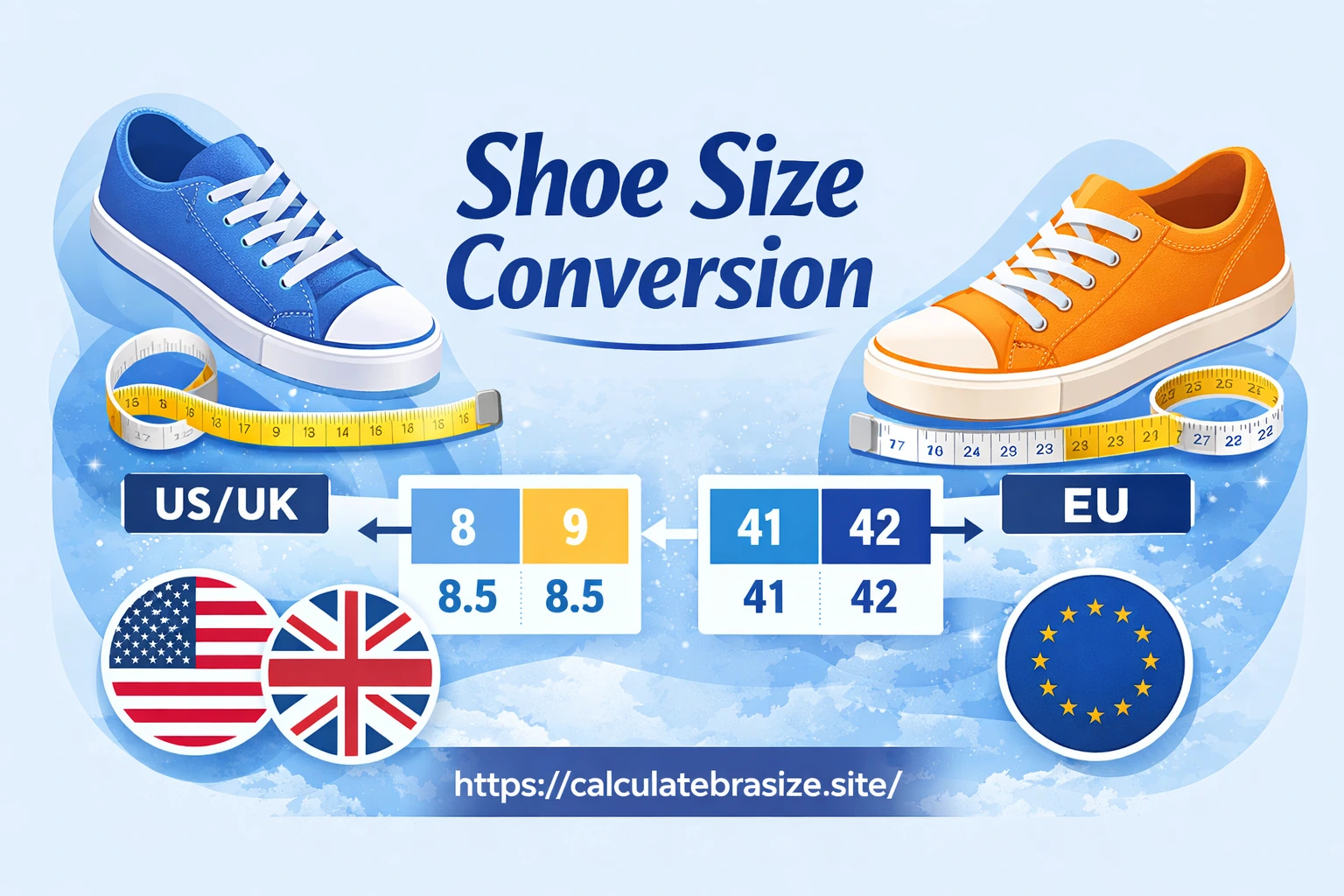
The European size system is unique because it generally lacks “half sizes” in the same way the American system uses them. Because a Paris Point (6.67 mm) is much smaller than a Barleycorn (8.46 mm), there are more full European sizes to cover the same spectrum of foot lengths as American sizes. A whole EU size essentially functions like a half US size.
When you look at an EU shoe size chart, you will notice that US sizes often map to a range of EU sizes. For example, a US size 7 could be an EU 37 or an EU 38. This mapping discrepancy is why relying on a dedicated foot size converter that takes specific millimeters into account is so vital.
Additionally, if you are buying shoes manufactured in Italy or Spain, expect the fit to be naturally narrower and sleeker. European shoe lasts (the wooden or plastic molds over which shoes are constructed) generally have a lower instep volume and a tapered toe compared to American lasts, which favor a wider and rounder toe box. Therefore, if you are an American converting to an EU size and you have a mildly wide foot, you may need to size up by one full EU size to accommodate the loss of width.
6. Decoding Widths: Narrow, Standard, Wide, and Extra Wide
A common mistake is assuming that shoe size is only a measure of length from heel to toe. The literal volume of your foot is equally important. If your foot size chart indicates you are a size 8 in length, but the shoe is painfully restricting the sides of your feet, you don’t necessarily need a size 9—you need a size 8 Wide.
Choosing a longer shoe to compensate for a wide foot is a massive orthopedic error. The arch support and the natural bend point of the shoe will be misaligned with your foot joints, severely altering your biomechanics.
In the United States, widths are categorized by a letter system. Here is the breakdown for women:
- AAA / AA / A: Narrow / Extra Narrow
- B / M: Standard / Medium (This is the default width unless otherwise specified)
- C / D: Wide
- E / EE / EEE: Extra Wide
If you look at an EU shoe size chart, you will notice that the EU system rarely deploys these letter grades. Standard European footwear is typically closer to an American A or B width. If you require a wide fit (D or E), you must specifically seek out European brands that explicitly manufacture wide-fit lines, or opt for footwear made from highly pliable materials like ultra-soft suede or stretch knits that can mold around a wider foot.
7. How Different Shoe Styles Affect Your Fit
Your results on a foot size conversion chart are not a static, universally applicable number. 39 in a strappy sandal is very different from a 39 in a winter boot. Shoe architecture drastically affects how sizing behaves.
High Heels and Pumps
When you wear high heels, gravity forces your foot down a sharp incline, pushing your toes into the furthest constraints of the toe box. Your heel also becomes prone to slipping out of the back. Because of this downward slide, many women prefer to size down by half a size in pumps and heels to ensure a snug, blister-free fit around the heel counter.
Running Shoes and Athletic Sneakers
During cardiovascular exercise, the increased blood flow causes significant foot swelling. Furthermore, the repetitive pounding forces the foot to splay outward and forward. In the athletic world, podiatrists universally recommend sizing up by half a size, or even a full size compared to your daily dress shoe size. Your longest toe should have a full thumb’s width of space between it and the end of the sneaker.
Winter Boots
Winter boots require extra volume. You will likely be wearing thick, thermal wool socks rather than thin stockings. Additionally, the interior of the boot is often lined with faux-fur or fleece, which occupies valuable real estate inside the shoe. When using a shoe size conversion table for winter boots, you should almost always size up.
Pointed-Toe Flats
Pointed-toe shoes artificially truncate the natural span of your toes, aggressively squeezing them into a triangle. To avoid severe pinching, blisters, and long-term joint pain, women with wider feet should completely avoid radically pointed toes or size up significantly so the toes sit behind the sharpest taper of the shoe.
8. Practical Use Cases for a Foot Size Converter
Why would you need a dedicated foot size converter in your daily life? Utilizing an automated digital converter removes the mathematical guesswork and protects your wallet.
Use Case 1: Global E-Commerce Shopping Imagine you are browsing an online boutique located in London that imports Italian leather loafers. You fall in love with a pair, but all the drop-down menu options read: 37, 38, 39, 40. You typically wear a US size 7.5. Instead of guessing and risking a costly international return process containing customs fees, you run the numbers through an automated tool to discover that an EU 38 is your optimal match.
Use Case 2: Buying Shoes as Gifts You want to surprise your mother with a pair of highly-reviewed orthopedic walking shoes from a German manufacturer for her birthday. You know she wears a US 9 Wide. You can use the converter to determine her EU equivalent (usually a 40) and investigate whether the brand accommodates wider fittings naturally.
Use Case 3: Purchasing Niche Footwear Specialty footwear—such as climbing shoes, cycling cleats, weightlifting shoes, or professional ballet pointe shoes—frequently rely on EU sizing or exact millimeter constraints (Mondopoint) due to the necessity for microscopic precision in fit. Athletes regularly use conversion tools to dial into exact, millimeter-perfect performance fits.
9. Using Our Shoe Size Converter Tool
Instead of memorizing a shoe size conversion table or attempting to perform mental arithmetic every time you shop, we highly recommend utilizing our digital solution.
You can calculate this easily using our Shoe Size Converter calculator.
How to Use the Tool Effectively:
- Select your gender identity (as US women’s and men’s baselines differ significantly).
- Input the primary size you already know, or input your exact foot length in centimeters/inches (obtained via the step-by-step guide from Section 2).
- The tool will instantly cross-reference algorithms to generate your exact equivalent in US, EU, UK, and JP sizing.
- Use this output as your trusted anchor point whenever browsing international retailers.
10. Common Mistakes When Converting American Shoe Size to EU
When dealing with a foot size chart, human error is the biggest obstacle to a comfortable fit. Avoid these frequent missteps:
- Mistake #1: Ignoring Brand Variations. A Nike EU 39 is not identical to a Gucci EU 39. Athletic brands tend to run small, while luxury European brands tend to run slightly large. Always, always check the specific brand’s internal size chart and customer reviews before trusting a general internet convention.
- Mistake #2: Assuming Men’s and Women’s EU Sizes are Different. In the US, a men’s 7 is a women’s 8.5. In the European system, an EU 40 is an EU 40. The length of the shoe last is identical regardless of gender, though a brand may alter the width. If you are a woman looking to buy a men’s sneaker, simply use your known EU size!
- Mistake #3: Forgetting About Socks. If you measure your barefoot using a ruler and buy an exact European match, you will be deeply disappointed when you try to put on a pair of thick athletic socks. If you plan to wear socks, measure your feet while wearing those exact socks.
- Mistake #4: Measuring Too Early. As emphasized earlier, if you measure your feet at 8:00 AM, the EU to US shoe size you calculate will be totally inaccurate by 5:00 PM due to daily fluid retention and gravity-induced swelling.
11. Pro Tips for Finding the Perfect Fit Online
Arming yourself with an accurate US foot size to EU conversion is only half the battle. Here are professional trade secrets for conquering online shoe shopping:
- Read the Reviews Analytically: Do not just look at the star rating. Search the review text for keywords like “runs small,” “true to size (TTS),” “narrow toe box,” and “stretches out.” Aggregating this data will tell you if you need to manipulate your converted shoe size up or down.
- Trace the Outsole: A brilliant hack is evaluating the images of the bottom of the shoe (the outsole). Does the sole look drastically curved like a banana? Does it pinch sharply at the toe? Compare the visual geometry of the sole to the outline of a shoe you already own and love.
- Materials Matter Heavily: A patent leather stiletto is rigid and completely unforgiving; if it is tight on day one, it will be tight on day one hundred. Conversely, genuine suede or soft primeknit meshes will aggressively stretch and mold to your foot over time. Buy rigid materials with plenty of room, but buy pliable materials perfectly snug.
- Utilize the Squeeze Test: When you receive the shoes, try them on indoors on a soft carpet. Push your thumb against the toe box. You should have between index finger’s width (about half an inch) of space between your longest toe and the tip of the shoe.
12. Conclusion
Navigating the landscape of global footwear should not feel like trying to decipher an ancient mathematical cipher. By utilizing a reliable foot size chart, measuring your feet in the evening, and understanding the physiological realities of how shoes fit across different styles and materials, you empower yourself as a consumer.
Whether you are converting an American shoe size to EU to purchase a luxury pump from Milan, or analyzing an eu shoe size chart to grab some discounted British rain boots, accuracy is everything. Protect your joints, safeguard your posture, and respect the anatomy of your foot by stepping into the world with precision.
Never settle for an uncomfortable squeeze or a sloppy, sliding heel. Take out your ruler, determine your exact baselines in centimeters, and don’t forget that you can always calculate this easily using our Shoe Size Converter tool to guarantee your next purchase is absolutely perfect.
Frequently Asked Questions (FAQs)
1. Is a size 41 an American size 8 or 9?
For women, an EU 41 generally translates to an American size 9.5 or 10. For men, an EU 41 generally translates to a US size 8 or 8.5.
2. How do you convert men’s shoe sizes to women’s?
In the United States, there is a 1.5 size mathematical difference between genders. To find a women’s size, simply take the men’s size and add 1.5. For example, a men’s size 7 is equivalent to a women’s size 8.5. In the European system, sizing is unisex based purely on length.
3. Are men’s shoes wider than women’s shoes?
Yes. In the United States, a standard “Medium” width for women is designated as a ‘B’, whereas a standard “Medium” width for men is designated as a ‘D’. If a woman with a wide foot purchases a men’s shoe, she will often find it much more comfortable around the the ball of the foot.
4. Why does my converted EU size sometimes feel completely wrong?
This happens due to brand-specific manufacturing lasts, the shape of the toe box, and the lack of European half-sizes. Additionally, a US foot size conversion chart only calculates length; if the European shoe is culturally manufactured to be much narrower than American standards, your foot will feel cramped regardless of the length.
5. Do my feet really get bigger as I age?
Yes, but they do not necessarily grow in bone length. Over decades, the tendons and ligaments supporting your foot arch gradually stretch and lose elasticity. As the arch flattens out, your foot physically sways forward and widens, frequently causing adults to go up half a size or even a full size as they get older.
6. I am an American traveling to Europe. Should I pack sneakers or buy them there?
Pack your absolute most comfortable, impeccably broken-in sneakers. European travel involves rigorous amounts of daily walking on uneven cobblestones. Attempting to figure out an eu shoe size chart in a foreign language while suffering from jet-lagged, swollen feet is a recipe for catastrophic blisters. Buy fashion shoes there, but bring your walking shoes from home!