Introduction: Why the Scale Is No Longer Enough
For decades, Body Mass Index (BMI) has been used as a shortcut for evaluating health. While convenient, BMI is blunt, it compares weight to height but ignores fat distribution, muscle mass, bone density, and metabolic risk.
Modern health science now favors geometric body shape analysis, which examines how fat and mass are distributed across the body. This is where a Body Shape Calculator guide becomes invaluable.
Rather than asking “How much do you weigh?”, it asks a more meaningful question:
“Where does your body store mass, and what does that mean for your health and appearance?”
What Is a Body Shape Calculator?
A Body Shape Calculator analyzes proportional relationships between key circumference measurements such as:
- Shoulders
- Bust or chest
- Waist
- Hips
Using mathematical thresholds and ratios, it categorizes the body into standardized silhouettes. These classifications are used in:
- Preventive health screening
- Metabolic risk assessment
- Ergonomic and orthopedic analysis
- Fashion and garment engineering
Unlike BMI, body shape analysis reflects how the body actually functions.
Why Your Body Shape Matters
1. Health Perspective: Visceral Fat vs. Subcutaneous Fat
Fat location is a stronger predictor of disease risk than total body weight.
Visceral Adipose Tissue (VAT)
- Stored deep inside the abdomen
- Surrounds vital organs (liver, pancreas, heart)
- Acts as an endocrine organ
- Releases inflammatory compounds linked to:
- Type 2 diabetes
- Cardiovascular disease
- Insulin resistance
VAT is commonly associated with Apple (Oval) body shapes.
Subcutaneous Fat
- Stored beneath the skin
- Common in hips and thighs
- Metabolically less dangerous
- In some cases, protective
This pattern is typical of Pear (Triangle) shapes.
Style Perspective: Proportional Harmony
In fashion science, body shape acts as a structural blueprint.
Designers use silhouette analysis to:
- Balance visual proportions
- Guide garment cuts and seam placement
- Optimize fabric drape and volume
The goal isn’t to “change” the body but to work with its geometry
How to Measure Your Body Correctly (Step-by-Step)
Accurate results depend on standardized anthropometric measurement.
Measurement Guidelines
- Use a soft, non-stretch tape
- Stand upright in a relaxed posture
- Do not pull the tape tightly
- Measure directly on skin or thin clothing
Key Measurements
1. Shoulders
Measure around the broadest part of the shoulders.
2. Bust / Chest
- Women: fullest part of the bust (wear a supportive, unpadded bra)
- Men: fullest part of the chest
3. Natural Waist
The narrowest point of the torso, usually 1–2 inches above the navel.
4. High Hip
Upper hip area over the pelvic bones.
5. Full Hip
Widest part of the buttocks with feet together.
Decoding the Primary Body Shape Types
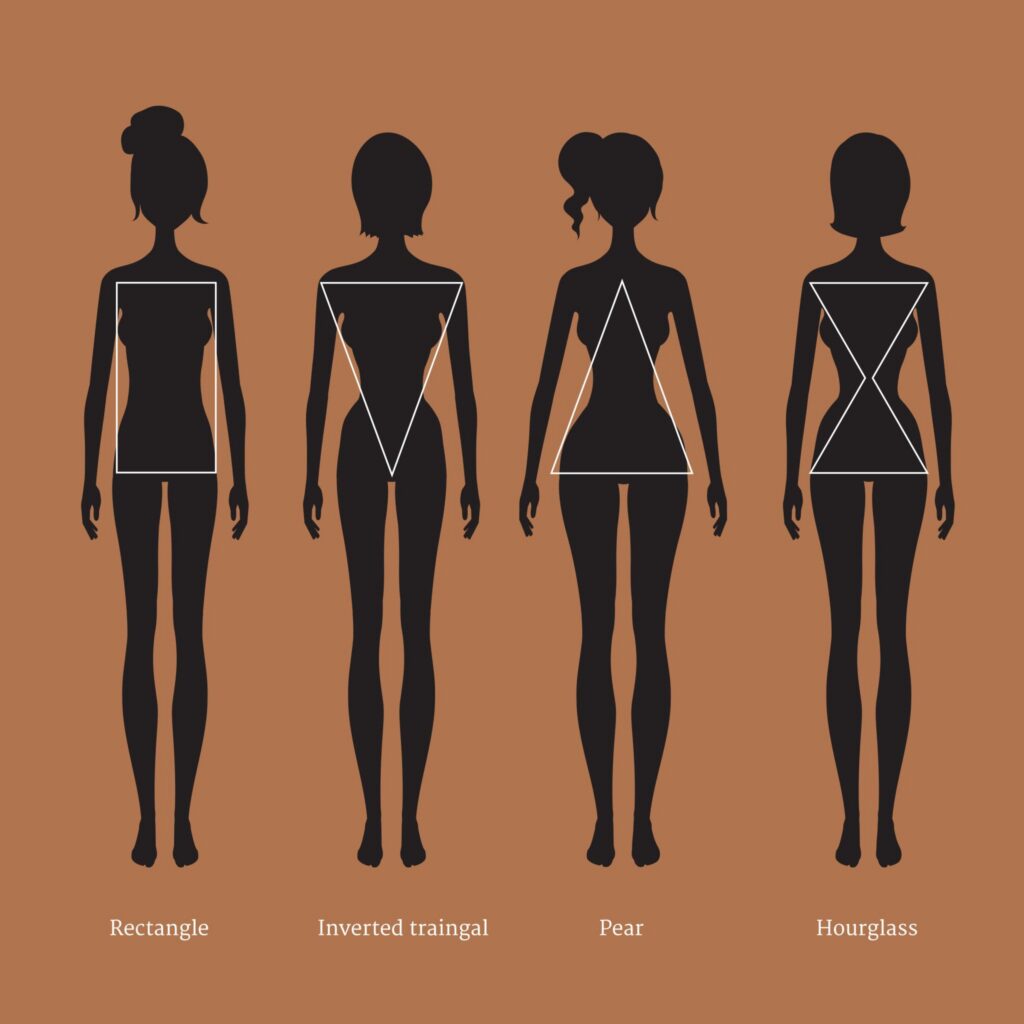
Hourglass (Balanced Shape)
Math Criteria
- Shoulders ≈ hips (within 5%)
- Waist ≥ 25% smaller than bust and hips
Health
- Generally lower metabolic risk if waist remains within healthy limits
Styling
- Wrap tops
- Belted dresses
- Waist-defined silhouettes
Triangle / Pear (Bottom-Heavy)
Math Criteria
- Hips ≥ 5% wider than shoulders or bust
Health
- Lower cardiometabolic risk
- Possible joint strain (knees, hips)
Styling
- Boat necks
- Statement shoulders
- A-line skirts
Inverted Triangle (Top-Heavy)
Math Criteria
- Shoulders or bust ≥ 5% wider than hips
Health
- Often athletic
- Fat may accumulate in upper torso
Styling
- V-necklines
- Flared skirts
- Straight or wide-leg trousers
Rectangle / Straight (Athletic)
Math Criteria
- Bust, waist, hips within 5%
- Minimal waist indentation
Health
- Risk depends on muscle-to-fat ratio
- Watch for “normal-weight obesity”
Styling
- Peplum tops
- Layering
- Structured tailoring
Apple / Oval (Midsection-Heavy)
Math Criteria
- Waist equal to or larger than hips and bust
Health
- Highest metabolic risk
- Strongly linked to visceral fat accumulation
Styling
- Empire waistlines
- Vertical lines
- Open blazers and long layers
Advanced Metrics Used by Body Shape Calculators
Waist-to-Hip Ratio (WHR)
- Men: Risk > 0.90
- Women: Risk > 0.85
Waist-to-Height Ratio (WHtR)
- Ideal: ≤ 0.5
- Simple rule: Keep your waist under half your height
Body Roundness Index (BRI)
- Estimates total body fat and visceral fat
- Height-independent
- Increasingly used in research
Hormones, Genetics, and Fat Distribution
Your silhouette reflects biology, not willpower.
Estrogen
- Promotes fat storage in hips and thighs
- Declines during menopause → shape shifts toward Apple
Cortisol
- Stress hormone
- Drives visceral fat accumulation
Insulin
- High levels increase central fat storage
- Strongly linked to abdominal obesity
Genetics determine bone structure; lifestyle influences fat placement.
Technology vs. Home Body Shape Calculators
Home Calculators
- ~98% accurate for silhouette classification
- Ideal for health awareness and styling
Clinical & Advanced Tools
- DEXA scans: Bone density + regional fat
- Bioelectrical Impedance (BIA): Fat vs muscle (hydration-sensitive)
- 3D body scanners: Precision fashion and tailoring data
Conclusion: Understanding, Not Fighting, Your Shape
A body shape calculator represents a shift toward body neutrality and functional health.
It acknowledges:
- Bone structure is fixed
- Fat distribution is modifiable
- Health is about risk patterns, not appearance
Whether your goal is metabolic health, smarter styling, or long-term wellness, understanding your body’s geometry gives you clarity, control, and confidence.
Frequently Asked Questions (FAQs)
Is a body shape calculator more accurate than BMI?
Yes. BMI measures total mass only, while body shape calculators account for fat distribution, which is more predictive of health risks.
Can my body shape change over time?
Yes. Hormones, aging, stress, and fat gain or loss can shift your silhouette, though bone structure remains constant.
Which body shape is healthiest?
No shape is inherently “healthy,” but excess abdominal fat (Apple shape) carries higher metabolic risk.
Do men have body shapes too?
Absolutely. Men are commonly classified into rectangle, inverted triangle, oval, or trapezoid shapes.
How often should I measure my body shape?
Every 3–6 months is sufficient unless you are undergoing significant lifestyle or hormonal changes.