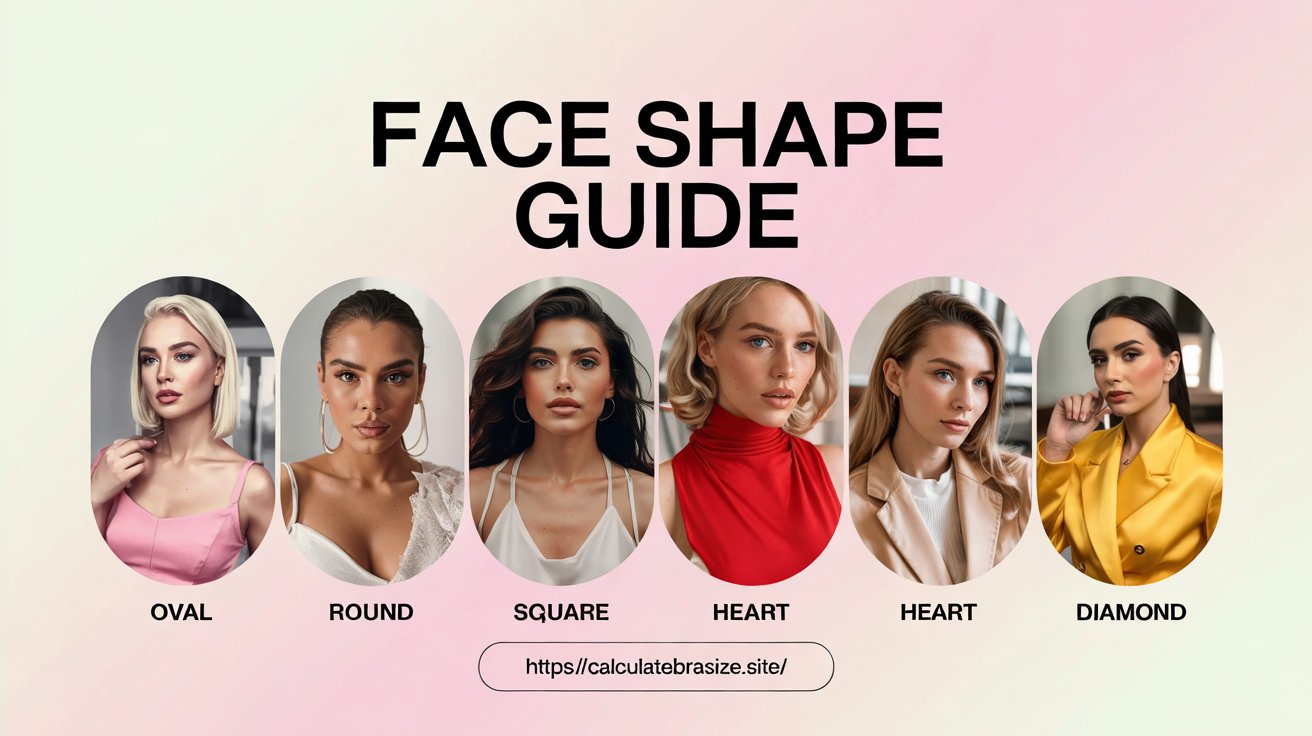
Your face shape is the silent architect of your entire look. It influences which hairstyles frame you best, which glasses complement your profile, how you should apply makeup, and even which accessories work in your favor. Yet surprisingly, most people have never actually identified their face shape or they have been guessing wrong all along.
This comprehensive guide walks you through everything you need to know about face shapes. You will learn how to accurately measure and identify your own face shape, explore the defining characteristics of every face type, and discover exactly how to use that knowledge to make better style choices whether you are a man or a woman.
Want instant results? Skip the manual measurements and use our free Face Shape Calculator to identify your face shape in seconds with AI-powered analysis.
What Is a Face Shape?
A face shape refers to the geometric outline formed by the contours of your forehead, cheekbones, jawline, and chin when viewed from the front. Think of it as the overall “frame” of your facet he silhouette that remains when you strip away hair, skin texture, and individual features.
While every face is unique in its exact proportions, facial structures tend to fall into recognizable categories. Dermatologists, stylists, makeup artists, and even plastic surgeons universally classify faces into common types based on the relative widths and angles of four key areas:
- Forehead width — How broad or narrow the top portion of your face is
- Cheekbone width — The widest point across the middle of your face
- Jawline width — How wide or narrow your jaw is at its widest point
- Face length — The vertical distance from hairline to chin tip
The relationship between these four measurements determines which of the major face shape categories you fall into.
Why Does Your Face Shape Matter?
Knowing your face shape is not mere vanity it is one of the most practical pieces of self-knowledge you can have. Here is why it matters across multiple areas of your life:
1. Hairstyles That Actually Flatter You
The single biggest reason people study face shapes is to choose better haircuts. A hairstyle that looks stunning on a magazine model with an oval face might look completely wrong on someone with a square or round face. When you know your shape, you can select cuts that balance your proportions rather than exaggerating them.
2. Glasses and Sunglasses That Fit Perfectly
Eyewear is one of the most visible accessories you wear. The wrong frame shape can make your face look wider, longer, or harsher than it is. The right frame creates visual harmony and draws attention to your best features.
3. Makeup and Contouring That Works
Professional makeup artists always assess face shape before contouring. The placement of bronzer, highlighter, and blush changes dramatically depending on whether you have a round, heart, or diamond-shaped face.
4. Hats, Jewelry, and Necklines
From earring shapes to neckline cuts on shirts and dresses, your face shape influences which accessories and clothing details complement your natural structure.
5. Confidence and Self-Awareness
Simply understanding your proportions helps you feel more confident in your choices. Rather than relying on trial and error, you can make informed decisions that consistently enhance your appearance.
How to Determine Your Face Shape: 3 Proven Methods
There are three reliable ways to figure out your face shape. You can use one method alone or combine all three for the most accurate result.
Method 1: The Measurement Method (Most Accurate)
This is the gold standard for face shape identification. You will need a flexible measuring tape (or a piece of string and a ruler) and a mirror.
Step 1: Measure Your Forehead Place the tape across the widest part of your forehead, typically halfway between your eyebrows and your hairline. Measure from one temple to the other. Write this number down.
Step 2: Measure Your Cheekbones Find the pointiest part of each cheekbone usually right below the outer corner of your eye. Measure straight across from one cheekbone to the other, crossing over the bridge of your nose.
Step 3: Measure Your Jawline Start at the base of your jaw directly below your ear. Measure along the edge of your jaw to the tip of your chin. Then multiply this number by two to get your full jawline width.
Step 4: Measure Your Face Length Measure from the center of your hairline straight down to the very tip of your chin.
Step 5: Compare Your Measurements
Once you have all four measurements, use this comparison chart:
| If your measurements show… | Your face shape is likely… |
|---|---|
| Face length > cheekbones > forehead > jawline, with a rounded chin | Oval |
| Cheekbones ≈ face length, all measurements are similar, soft jawline | Round |
| Forehead ≈ cheekbones ≈ jawline, with angular jaw | Square |
| Forehead > cheekbones > jawline, with pointed chin | Heart |
| Cheekbones > forehead ≈ jawline, with angular features | Diamond |
| Face length >> all other measurements, similar widths | Oblong/Rectangle |
| Jawline > cheekbones > forehead | Triangle (Pear) |
| Forehead > jawline, with similar cheekbone and jawline widths | Inverted Triangle |
Skip the math: Our Face Shape Calculator does all of this instantly using AI facial landmark detection just upload a photo.
Method 2: The Mirror Tracing Method
This is a quick visual method that requires no tools:
- Pull all your hair back away from your face.
- Stand about 12 inches from a well-lit mirror.
- Using a dry-erase marker, lipstick, or bar of soap, trace the outline of your face on the mirror’s surface.
- Step back and examine the shape you drew.
- Compare the outline to the face shape diagrams below.
Method 3: The Photo Analysis Method
- Take a straight-on selfie in good, even lighting with your hair pulled back.
- Open the photo on your phone or computer.
- Using a photo editing app, draw lines along your hairline, cheekbones, and jawline.
- Examine the resulting shape.
For the most effortless and accurate approach, upload your photo to our Face Shape Calculator, which uses AI to detect over 400 facial landmarks and classify your face shape with precision.
The 9 Face Shapes Explained in Detail
While some resources simplify this to 6 or 7 shapes, there are actually 9 distinct face shape categories widely recognized by dermatologists, beauty professionals, and facial analysis experts.
1. Oval Face Shape
Key Characteristics:
- Face length is approximately 1.5 times the width
- Cheekbones are the widest part of the face
- Forehead is slightly wider than the jawline
- Chin is gently rounded (not pointed, not square)
- Facial contours have soft, balanced curves
Why It Is Considered the “Ideal”: The oval face is universally regarded as the most balanced and proportionate face shape. Its gentle tapering from cheekbones to forehead and chin creates symmetry that is considered classically attractive across cultures. Most styling advice aims to create the illusion of an oval shape for other face types.
Celebrity Examples: Beyoncé, George Clooney, Jessica Alba, Ryan Gosling, Bella Hadid.
Best For: Virtually any hairstyle, frame shape, or makeup technique. Oval faces have the most versatility.
2. Round Face Shape
Key Characteristics:
- Face length and width are nearly equal
- Cheekbones are the widest feature, with full cheeks
- Soft, rounded hairline (no angular corners)
- Jawline is smooth and undefined, with no sharp angles
- Chin is small and rounded
- Overall appearance is youthful and soft
How to Tell If Your Face Is Round vs. Oval: The key difference is proportional. If your face length is noticeably longer than its width, you are oval. If the length and width are approximately equal, you are round. Round faces also lack the gentle tapering that oval faces have.
Celebrity Examples: Selena Gomez, Chrissy Teigen, Leonardo DiCaprio (younger), Jack Black, Ginnifer Goodwin.
Styling Goal: Add angles and elongation to create the illusion of length.
3. Square Face Shape
Key Characteristics:
- Forehead, cheekbones, and jawline are all approximately the same width
- Strong, angular jawline with sharply defined corners
- Broad, flat forehead with a relatively straight hairline
- Face width and length are similar (like a round face but with angles)
- Prominent cheekbones that align with the jaw
Celebrity Examples: Angelina Jolie, Olivia Wilde, Brad Pitt, Henry Cavill, Keira Knightley.
Styling Goal: Soften the strong angular lines and create length.
4. Heart Face Shape
Key Characteristics:
- Forehead is the widest part of the face
- Cheekbones are wide and pronounced
- Face narrows significantly toward the chin
- Chin is pointed or narrow
- A widow’s peak hairline is common (though not required)
- Resembles an inverted triangle with a pointed base
Celebrity Examples: Reese Witherspoon, Scarlett Johansson, Ryan Reynolds, Taylor Swift.
Styling Goal: Balance the wider upper face by adding width or softness near the jawline and minimizing forehead emphasis.
5. Diamond Face Shape
Key Characteristics:
- Cheekbones are the widest and most prominent feature
- Forehead is narrow (narrower than cheekbones)
- Jawline is narrow and comes to a subtle point
- Face length is the longest measurement
- Angular features throughout, giving a “sculpted” appearance
- One of the rarest face shapes
Celebrity Examples: Rihanna, Robert Pattinson, Vanessa Hudgens, Halle Berry.
Styling Goal: Soften the cheekbones and add perceived width to the forehead and jawline for balance.
6. Oblong (Long) Face Shape
Key Characteristics:
- Face is significantly longer than it is wide
- Forehead, cheekbones, and jawline are similar in width
- Sides of the face appear relatively straight
- Chin is rounded (distinguishing it from rectangle)
- Forehead is typically tall
- Cheeks may appear elongated
How to Tell Oblong vs. Oval: Both are longer than wide, but oblong faces have more uniform width from forehead to jaw, while oval faces taper noticeably. Oblong faces also tend to have a notably longer face length relative to width.
Celebrity Examples: Sarah Jessica Parker, Adam Driver, Liv Tyler, Ben Affleck.
Styling Goal: Create the illusion of width and break up the length.
7. Rectangle Face Shape
Key Characteristics:
- Similar to oblong, but with angular features
- Face is longer than it is wide
- Forehead, cheekbones, and jawline are approximately equal in width
- Jawline is strong and angular (unlike the rounded jaw of oblong)
- Combines the length of oblong with the angles of square
- Straight sides and a defined jaw
Celebrity Examples: Meryl Streep, Idris Elba, Sarah Paulson.
Styling Goal: Add width while softening the jawline angles.
8. Triangle (Pear) Face Shape
Key Characteristics:
- Jawline is the widest part of the face
- Face narrows upward toward a smaller forehead
- Cheekbones sit between forehead and jawline in width
- Chin is wide and may be flat or rounded
- Forehead is noticeably narrow
Celebrity Examples: Minnie Driver, Eli Manning.
Styling Goal: Add width to the upper face (forehead and cheekbones) while minimizing jaw emphasis.
9. Inverted Triangle Face Shape
Key Characteristics:
- Forehead is the widest measurement
- Face narrows dramatically toward the jaw and chin
- Jawline is narrow and tapered
- Similar to heart shape but without the pointed chin
- Chin may be more squared off while still narrower than the forehead
Celebrity Examples: Naomi Campbell, Jennifer Love Hewitt.
Styling Goal: Minimize forehead width while adding fullness around the jawline area.
Face Shapes for Women: A Complete Visual Guide
Understanding face shapes is particularly important for women because of the vast number of style choices influenced by facial structure from short pixie cuts to long flowing layers, from dramatic contouring to subtle everyday makeup, and from statement earrings to delicate studs.
Quick Reference: Female Face Shapes at a Glance
| Face Shape | Widest Point | Jawline | Chin | Proportions |
|---|---|---|---|---|
| Oval | Cheekbones | Soft, tapered | Rounded | Length > Width |
| Round | Cheekbones/Cheeks | Soft, undefined | Rounded | Length ≈ Width |
| Square | Even throughout | Angular, strong | Flat/Wide | Length ≈ Width |
| Heart | Forehead | Tapered | Pointed | Wide top, narrow bottom |
| Diamond | Cheekbones | Narrow, angular | Pointed | Narrow top and bottom |
| Oblong | Even throughout | Soft | Rounded | Length >> Width |
| Rectangle | Even throughout | Angular | Flat | Length >> Width |
| Triangle | Jawline | Wide, strong | Wide | Narrow top, wide bottom |
| Inverted Triangle | Forehead | Narrow | Narrow | Wide top, narrow bottom |
The most common face shapes among women are oval, round, and heart. Diamond and triangle are the rarest.
Face Shapes for Men: A Complete Visual Guide
For men, face shape knowledge drives decisions around haircuts, beard styles, and eyewear three of the biggest factors in a man’s overall appearance.
Quick Reference: Male Face Shapes at a Glance
| Face Shape | Defining Feature | Best Assets | Common Look |
|---|---|---|---|
| Oval | Balanced proportions | Versatility | Classic, refined |
| Round | Full cheeks, soft jaw | Youthful appearance | Soft, approachable |
| Square | Strong jawline | Masculine definition | Rugged, strong |
| Heart | Wide forehead, narrow chin | Cheekbone definition | Distinguished |
| Diamond | Prominent cheekbones | Sculpted look | Angular, striking |
| Oblong | Length dominates | Mature, distinguished | Elongated, lean |
| Rectangle | Long + angular | Strong structure | Commanding |
| Triangle | Wide jaw | Strong foundation | Sturdy, grounded |
The most common face shapes for men are oval, square, and round. Square and rectangle shapes tend to be perceived as the most traditionally masculine due to their strong jaw definition.
Best Hairstyles for Each Face Shape (Women)
Oval Face — Almost Anything Works
The oval face can pull off the widest range of styles. Long layers, blunt bobs, pixie cuts, curtain bangs, and high ponytails all work beautifully. The only rule is to avoid extreme volume on top, which can elongate an already balanced face.
Top Picks: Long layers, French bob, textured pixie, curtain bangs, face-framing waves.
Round Face — Create Length and Angles
Choose styles that add height on top and create the illusion of a longer face. Avoid blunt cuts at chin level that accentuate width.
Top Picks: Long layers with a deep side part, asymmetrical lob, high ponytail, side-swept bangs, angular bobs.
Square Face — Soften the Angles
Opt for styles that soften the strong jawline. Soft waves, wispy layers, and side parts work better than blunt, geometric cuts.
Top Picks: Soft waves past the shoulders, wispy side-swept bangs, long layered cuts, textured bobs, face-framing layers.
Heart Face — Balance the Width
Add volume around the jawline while keeping the forehead area softer. Side-swept bangs help reduce the visual width of the forehead.
Top Picks: Chin-length bob, curtain bangs, soft layers that start at the jaw, medium-length waves, side-swept fringe.
Diamond Face — Highlight and Frame
Use fringes to add width to the forehead and layers that fall around the jawline to balance the prominent cheekbones.
Top Picks: Side-swept bangs, chin-length bobs, long layers starting below the cheekbones, textured lobs.
Oblong/Rectangle Face — Add Width, Reduce Length
Choose styles that add volume at the sides and avoid adding excessive height on top.
Top Picks: Shoulder-length cuts with layers, side-swept or blunt bangs to shorten the forehead, wavy bobs, textured medium-length styles.
Triangle Face — Volume on Top
Create balance by adding volume and width in the upper portion of the face.
Top Picks: Voluminous blowouts, side-parted styles with top volume, layered cuts with fullness at the cheekbones, textured pixie cuts.
Best Hairstyles for Each Face Shape (Men)
Oval Face
Best: Short textured crop, classic side part, pompadour, quiff, crew cut, undercut. Avoid: Overly voluminous styles or man buns that elongate the face.
Round Face
Best: Pompadour, high fade with textured top, angular fringe, spiky styles with height. Avoid: Buzz cuts or rounded styles that emphasize the circular shape.
Square Face
Best: Short textured crop, French crop, side part, quiff with some height. Avoid: Extremely boxy or flat-top cuts that exaggerate the square proportions.
Heart Face
Best: Forward-facing textured fringe, medium-length side-swept styles, longer layered cuts. Avoid: High quiffs or pompadours that add vertical emphasis to the wide forehead.
Diamond Face
Best: Messy fringe, layered cuts with volume, textured medium-length styles. Avoid: Short sides with no top length, which emphasizes the narrow forehead.
Oblong/Rectangle Face
Best: Side-swept fringe, mid-length layered cuts, styles that add width at the sides. Avoid: Tall pompadours or styles that add height and make the face look even longer.
Triangle Face
Best: Longer top with tapered sides, volume on top, textured styles with width near the temples. Avoid: Styles that are very short on top but wide at the jaw level.
Best Glasses and Sunglasses for Each Face Shape
The golden rule of eyewear is contrast: choose frame shapes that contrast with your face shape to create visual balance. According to leading optometry organizations like the American Academy of Ophthalmology, the right frames can enhance your features while the wrong ones can create visual disharmony.
| Face Shape | Best Frame Styles | Avoid |
|---|---|---|
| Oval | Almost any style — aviator, wayfarer, round, cat-eye, rectangular | Frames wider than the broadest part of your face |
| Round | Angular, rectangular, square, geometric, cat-eye, browline | Small round frames that echo facial curves |
| Square | Round, oval, cat-eye, rimless, thin-framed | Thick angular or boxy frames |
| Heart | Bottom-heavy frames, aviator, round, oval, rimless | Top-heavy or overly wide frames |
| Diamond | Oval, rimless, cat-eye, browline, semi-rimless | Narrow frames that emphasize width |
| Oblong | Deep frames with more height than width, decorative temples | Small or narrow frames |
| Triangle | Cat-eye, browline, frames with top-heavy detailing | Bottom-heavy or narrow frames |
Makeup and Contouring Tips by Face Shape
Contouring is the art of using light and shadow to sculpt your face, and the placement changes dramatically depending on your face shape. Here are the expert-recommended techniques for each shape:
Oval Face Contouring
- Contour: Lightly under the cheekbones, along the temples, and under the outer jawline
- Highlight: Center of forehead, bridge of nose, tops of cheekbones, chin
- Goal: Enhance natural symmetry without over-sculpting
Round Face Contouring
- Contour: Deeply under the cheekbones in an angular motion, along the outer jawline from ear to chin
- Highlight: Upper cheekbones, brow bones, bridge of nose
- Goal: Create angular definition and the illusion of length
Square Face Contouring
- Contour: The four corners of the face (temples and jaw corners), along the sides of the forehead
- Highlight: Center of forehead, bridge of nose, tops of cheekbones, center of chin
- Goal: Soften and round the angular features
Heart Face Contouring
- Contour: Temples and outer forehead to reduce width, lightly along the hollows of cheeks
- Highlight: Center of chin (to broaden it), center of forehead, under eyes
- Goal: Balance the wider upper face with the narrower chin
Diamond Face Contouring
- Contour: Tips of cheekbones (not underneath), sides of forehead and jawline
- Highlight: Center of forehead and chin to add width to narrow areas
- Goal: Soften the prominent cheekbones and balance proportions
Oblong/Rectangle Face Contouring
- Contour: Along the hairline to reduce forehead height, under the chin to shorten length
- Highlight: Tops of cheekbones (horizontal application), brow bone
- Goal: Create width and visually shorten the long face
Face Shape and Beard Styles for Men
For men, facial hair is one of the most powerful tools for reshaping the perceived contours of your face. The right beard style can add angles to a round face, soften a square jaw, or balance an elongated face.
| Face Shape | Best Beard Styles | Why It Works |
|---|---|---|
| Oval | Almost any style — full beard, stubble, goatee | Balanced proportions allow versatility |
| Round | Angular goatee, pointed beard, chinstrap variants | Adds vertical definition, elongates the face |
| Square | Full rounded beard, circle beard, medium stubble | Softens the sharp jaw corners |
| Heart | Full beard with volume at the jaw, wider goatee | Adds width to the narrow lower face |
| Diamond | Full beard, rounded styles, chin-focused growth | Adds width to the narrow jaw area |
| Oblong | Short beard, mutton chops, stubble, sideburns with width | Adds horizontal width, avoids adding length |
| Triangle | Stubble, short boxed beard, avoid jaw-heavy styles | Softens the already wide jawline |
How AI Face Shape Detectors Work
Modern face shape detectors use sophisticated artificial intelligence to analyze photographs and determine face shape automatically. Here is how the technology works behind the scenes:
Step 1: Image Processing
When you upload a photo, the AI system first preprocesses the image—adjusting brightness, removing noise, and standardizing the size for consistent analysis.
Step 2: Facial Landmark Detection
Advanced AI models identify key points on your face called facial landmarks. Modern systems like Google’s MediaPipe can detect over 468 individual landmarks, mapping precise locations around your:
- Hairline and forehead contour
- Eyebrows and eye sockets
- Cheekbone prominence
- Nose bridge and tip
- Jawline from ear to chin
- Chin contour and tip
Step 3: Measurement and Ratio Calculation
The system measures the distances and angles between landmarks, calculating critical ratios such as:
- Face width-to-height ratio
- Forehead width vs. cheekbone width
- Cheekbone width vs. jawline width
- Jaw angle severity
- Chin shape classification
Step 4: Machine Learning Classification
These measurements are fed into a trained machine learning model (typically a Convolutional Neural Network or CNN) that has been trained on thousands of classified facial images. The model compares your ratios against known patterns for each face shape category and assigns the closest match.
Step 5: Results and Recommendations
The tool displays your determined face shape along with personalized recommendations for hairstyles, glasses, and other style choices.
Try it now: Our Face Shape Calculator uses this exact AI-powered process to give you instant, accurate results.
Face Shape vs. Head Shape: Is There a Difference?
Yes, face shape and head shape are related but distinct concepts.
Face shape refers to the frontal outline of your face what you see when you look straight into a mirror. It is determined by the soft tissue, bone structure, and fat distribution of the forehead, cheeks, jaw, and chin.
Head shape is the three-dimensional form of your entire skull, including the profile (side view), top view, and back. Head shapes include classifications like:
- Dolichocephalic (long and narrow)
- Brachycephalic (short and wide)
- Mesocephalic (medium proportions)
Your head shape becomes particularly relevant when choosing hats, helmets, and assessing your side profile. Your face shape is more relevant for hairstyles, glasses, makeup, and general aesthetics from the front.
The Most Common and Most Attractive Face Shapes
Most Common Face Shapes
Research published in the Journal of Craniofacial Surgery and various anthropometric studies indicate that the most common face shapes worldwide are:
- Oval — The most common overall
- Round — Particularly common in Asian populations
- Square — Common in men
- Heart — Common in women
The rarest shapes are diamond and triangle.
The “Most Attractive” Face Shape
Studies on facial attractiveness consistently point to the oval face as the most universally attractive, primarily because of its balanced proportions and symmetry. However, attractiveness is highly subjective and culturally influenced:
- Square faces are often considered the most attractive for men due to the strong jawline association with masculinity
- Heart and oval faces frequently rank highest for women in Western beauty standards
- Diamond faces are prized for their sculpted, editorial appearance
It is important to note that every face shape is attractive—the key is understanding how to style and present your unique structure to its best advantage.
Can Your Face Shape Change Over Time?
Yes, your face shape can shift throughout your life due to several factors:
Natural Aging
As you age, you lose subcutaneous fat in your face, and the skin begins to sag due to reduced collagen and elastin. A round face in your twenties may become more oblong or square in your fifties as fat diminishes around the cheeks and the jawline becomes more pronounced.
Weight Changes
Significant weight gain or loss affects the fat distribution in your face. Weight gain often makes faces appear rounder, while weight loss can reveal sharper jawlines and cheekbones.
Hormonal Changes
Puberty, pregnancy, menopause, and hormonal shifts can affect fat distribution and bone density in the face, subtly altering your face shape over time.
Dental and Orthodontic Work
Major dental procedures, jaw surgery, or years of orthodontic treatment can alter your jawline and chin structure, affecting your overall face shape.
Mewing and Jaw Exercises
While controversial, some practitioners of mewing (a tongue-posture technique) claim it can subtly reshape the jawline and midface over extended periods, particularly in younger individuals whose bones are still developing.
Final Thoughts
Your face shape is one of the most fundamental aspects of your physical identity—and understanding it gives you a genuine advantage in every style decision you make. From choosing the right haircut that frames your features beautifully to picking sunglasses that balance your proportions and applying makeup that sculpts your best angles, face shape knowledge transforms guesswork into confidence.
Whether you learned through careful measurements, mirror tracing, or a quick analysis with our AI-powered tool, the important thing is that you now understand your unique facial geometry and how to work with it—not against it.
Every face shape is beautiful. The goal is never to “fix” what you have, but to understand and enhance it.
Ready to discover your face shape?
Frequently Asked Questions
What face shape do I have?
To determine your face shape, you can take four key measurements: forehead width, cheekbone width, jawline width, and face length. Compare these to identify whether your face is oval, round, square, heart, diamond, oblong, rectangle, or triangle. For the fastest result, use our Face Shape Calculator which uses AI to analyze a photo and tell you instantly.
How do I determine my face shape?
There are three main methods: (1) Take physical measurements of your forehead, cheekbones, jawline, and face length using a flexible tape measure. (2) Trace the outline of your face on a mirror using a dry-erase marker. (3) Upload a front-facing photo to an AI face shape detector tool. All three methods compare your proportions to the standard face shape categories.
What is the most common face shape?
The oval face shape is generally considered the most common worldwide, followed closely by round and square. However, the distribution varies by ethnicity, age, and gender. For women, oval and heart shapes are the most prevalent. For men, oval and square shapes are most common.
What is the most attractive face shape?
While beauty is subjective, research consistently identifies the oval face as the most universally attractive due to its balanced and symmetrical proportions. However, square faces are particularly admired in men for their strong jawline, and heart-shaped faces are frequently highlighted as attractive in women.
Can I change my face shape?
Your basic bone structure is genetically determined and does not change without surgical intervention. However, factors like weight, aging, hairstyle, makeup contouring, and facial hair (for men) can significantly alter the perceived shape of your face. Major changes are possible through cosmetic procedures such as jaw contouring, chin implants, or buccal fat removal.
What is the difference between oval and oblong face shapes?
Both oval and oblong faces are longer than they are wide. The key difference is proportional balance: an oval face tapers gracefully from wider cheekbones to a narrower forehead and chin, creating a balanced egg-like shape. An oblong face has more uniform width from forehead to jaw, with less tapering, creating a longer and more rectangular appearance with softer corners.
How do AI face shape detectors work?
AI face shape detectors use computer vision and machine learning to analyze photographs. They detect facial landmarks (key points on the face), measure distances and angles between those points, calculate facial ratios, and compare them against trained models to classify the face shape. Advanced systems like Google’s MediaPipe can detect over 468 individual facial landmarks for highly accurate results.
What is the best hairstyle for my face shape?
The best hairstyle depends entirely on your face shape. The general principle is to choose styles that contrast with your natural proportions: round faces benefit from angular, elongating cuts; square faces look best with softer, layered styles; oblong faces need width-adding cuts; and oval faces can wear almost anything. Use our Face Shape Calculator to identify your shape and get personalized recommendations.
What glasses suit my face shape?
The rule of contrast applies: round faces suit angular frames, square faces suit round or oval frames, heart faces suit bottom-heavy or rimless frames, and oval faces can wear virtually any style. The goal is always to create visual balance between the frame shape and your facial contours.
Are face shape apps accurate?
AI-powered face shape apps have become remarkably accurate, especially those using advanced facial landmark detection with hundreds of data points. However, accuracy depends on photo quality—use a well-lit, front-facing photo with hair pulled back for the best results. Most quality apps achieve 85-95% accuracy when given a good photo.
What face shape do most models have?
Professional fashion models most commonly have oval or diamond face shapes. The oval shape’s balanced proportions photograph well from multiple angles, while the diamond shape’s prominent cheekbones create the striking, editorial look prized in high fashion. However, successful models exist with every face shape—diversity in the industry continues to grow.
Is my face round or oval?
The simplest test: if your face length and width are nearly equal, you have a round face. If your face is noticeably longer than it is wide (roughly 1.5:1 ratio), you have an oval face. Round faces also have softer, less defined jawlines, while oval faces taper toward the chin.